
Criminal Court Records in Perry County
A criminal court record is the full case file the Circuit Clerk opens once the State files a charge against a defendant. In Perry County the Circuit Clerk, Christy Mayo, keeps these files for the Circuit Court, the court that hears all felony prosecutions in the county. The file gathers every paper in the case. That includes the charging document, bond entries, the running docket of motions and orders, the plea or verdict, and the sentence. It is broader than a single arrest entry. The case file is the place where charges, hearings, and the final outcome all live together in one record.
Felony matters belong to Circuit Court. Justice Court and the municipal courts in Beaumont, New Augusta, and Richton handle misdemeanors and city ordinance matters, and appeals from Justice Court move up to Circuit Court. Perry County sits in the Twelfth Circuit Court District with Forrest County, where Judges T. Michael Reed and Wes Curry preside. For a wider view of every file type the courts keep, the county court records overview maps the Circuit and Chancery systems side by side.
How to Search Perry County Criminal Court Records
Mississippi Electronic Courts (MEC) is the statewide e-filing and case-management system, and the public reaches Circuit Court dockets through Public Access to MEC, known as PAMEC. Perry County Circuit Court went live on MEC on February 21, 2017, so cases from that date forward are electronic. A criminal case search runs through that account, by name or by case number.
- Register for a free viewer account through PAMEC online registration, which assigns a login name, password, and client code.
- Open the Twelfth Circuit district from the MEC general information page and choose the Perry County Circuit Court.
- Search by defendant name or by case number, then narrow the results by case type and filing date.
- Open the matching case to read the docket, the charges, and the disposition; some documents require login, payment, or permission to view.
- Order a certified copy from the Circuit Clerk when you need a version a court or agency will accept.
The Twelfth Circuit CourtInfo page lists the Perry County Circuit Court address, hours, and the flag definitions used on each docket. For records before the go-live date, or when a document is not online, call or visit the Circuit Clerk. Older paper files and sealed entries are handled at the counter, not through the public portal.
Stages of a Perry County Criminal Case
A felony case moves through fixed stages, and each stage leaves its own mark in the record. The docket reads as a timeline, with dated entries that show when charges were filed, when the defendant appeared, and when the judge ruled. Reading the file in order is the clearest way to see how a case ended.
Case flow: Charges Filed › Arraignment › Pretrial / Motions › Plea or Trial › Disposition › Sentencing
| Stage | What Happens |
|---|---|
| Charges Filed | A grand jury returns an indictment for a felony, or a charging instrument opens the case in the trial court. |
| Arraignment | The charges are read and the defendant enters a plea, or signs a written waiver of arraignment in place of the hearing. |
| Pretrial / Motions | Lawyers file motions, the judge issues orders, and the docket records continuances, bond reviews, and hearing settings. |
| Plea or Trial | The defendant pleads through a plea petition, or the case goes to a jury trial in Circuit Court. |
| Disposition | The case reaches an outcome: guilty, not guilty, dismissed, or a prosecutor's dismissal noted as nolle prosequi. |
| Sentencing | After a conviction or plea, the judge orders the sentence, which may include incarceration, probation, fines, and court costs. |
How a Perry County Felony Case Opens
Most Perry County felony files begin with a grand jury indictment. The Twelfth Circuit follows a set local routine after that point. A defendant who is out on bond is served with the indictment and a capias, which is the court's writ to take a person into custody, during the monthly felony bond sign-in. The record shows the date of service and the bond status at that moment.
Right after service, the defendant meets with a county public defender. With counsel's help, the defendant completes a Waiver of Arraignment, an Affidavit of Indigency, and an Order Appointing Counsel. The indigent appointment of counsel page describes this step for felony defendants who cannot afford a lawyer. Those signed forms become part of the case file and explain why the docket may show a public defender rather than a private attorney.
Felony bond sign-in is its own duty. Everyone out on felony bond must sign in with the Circuit Court each month, from the first day of the month through the second Wednesday. The felony bond sign-in page warns that a missed sign-in can lead to a bench warrant, which then appears on the docket. Common forms in a Perry County felony file include the following.
- Waiver of Indictment
- Waiver of Arraignment
- Plea Petition
- Affidavit of Indigency
- Order Appointing Counsel
Blank versions of several of these appear on the Twelfth Circuit court forms page, including the Perry plea petition.
What a Perry County Criminal Court Record Shows
A criminal court record is built from labeled fields, and each one answers a different question about the case. The portal and the paper file use the same core data. Reading the fields in order tells you who was charged, what they were charged with, and how the matter ended.
| Field | What It Shows |
|---|---|
| Case Number | The court's unique identifier for the file, used to pull the docket and order copies. |
| Defendant | The person the State has charged, named opposite the State of Mississippi. |
| Charges | Each count as filed, with the offense and its level, felony or misdemeanor. |
| Plea | The defendant's response: guilty, not guilty, or no contest entered through a plea petition. |
| Motions and Orders | Dated docket entries for requests by the lawyers and rulings by the judge. |
| Disposition | The outcome of each count: conviction, acquittal, dismissal, or nolle prosequi. |
| Sentence | The punishment ordered after a conviction or plea, with any probation or supervision terms. |
| Status Flags | MEC labels such as Closed, Probation, Bench Warrant Issued, Sealed, or Expunged. |
Reading Dispositions and Sentences
The disposition is the outcome of a charge, and the sentence is what the court orders after a conviction or plea. A single case can carry more than one disposition when it has more than one count. Some counts may be dropped while others end in a plea. MEC flags help readers spot the current status without reading every entry. The terms below appear often on a Perry County criminal docket.
- Guilty plea
- The defendant admits the charge through a plea petition, and the court moves to sentencing.
- Nolle prosequi
- The prosecutor decides not to proceed on a charge, which ends that count without a conviction.
- Dismissed
- The court drops the charge, sometimes after a diversion program or a successful motion.
- Probation
- A court-supervised sentence served in the community instead of, or after, incarceration.
- Post-release supervision
- Supervision that continues after a term of incarceration ends.
- Bench warrant
- A warrant a judge issues, often after a missed appearance or a missed bond sign-in.
Note: A docket flagged For Sentence means the case has a finding of guilt but the sentence has not yet been entered.
Charges vs. Convictions in Perry County Records
Being charged is not the same as being convicted. A criminal court record can show charges that were later dropped, dismissed, or that ended in acquittal. A charge is an accusation that the case is just beginning to test. A conviction is a finding of guilt by plea or verdict. The closer look at how prosecutors file and amend counts lives in the county court charge records overview.
| Charge | Conviction | |
|---|---|---|
| Stage | Accusation at the start of a case | Verdict or plea at the end |
| Burden of Proof | Probable cause | Beyond a reasonable doubt |
| Can Change To | Amended, reduced, or dismissed | Final unless appealed or expunged |
| Public Record | Yes, in most adult cases | Yes, in most adult cases |
Statewide Criminal History Records
The court file covers one case at a time. A statewide criminal history is a different record. The Mississippi Department of Public Safety runs the central repository through its Criminal Information Center, which compiles arrest and disposition data reported by agencies across the state. That repository is the criminal-history channel, separate from any single Perry County case file held by the Circuit Clerk.
The DPS Criminal Information Center explains the repository's role and the rules for requesting a background check.

Unlike a court docket, a statewide history pulls together cases from many counties under one name. A Perry County felony and a charge from another county can appear on the same report. That is why the repository complements, rather than replaces, the local case file.
A formal background check needs the subject's signed release. The DPS background authorization form sets out that consent step before the state runs a name through the repository.
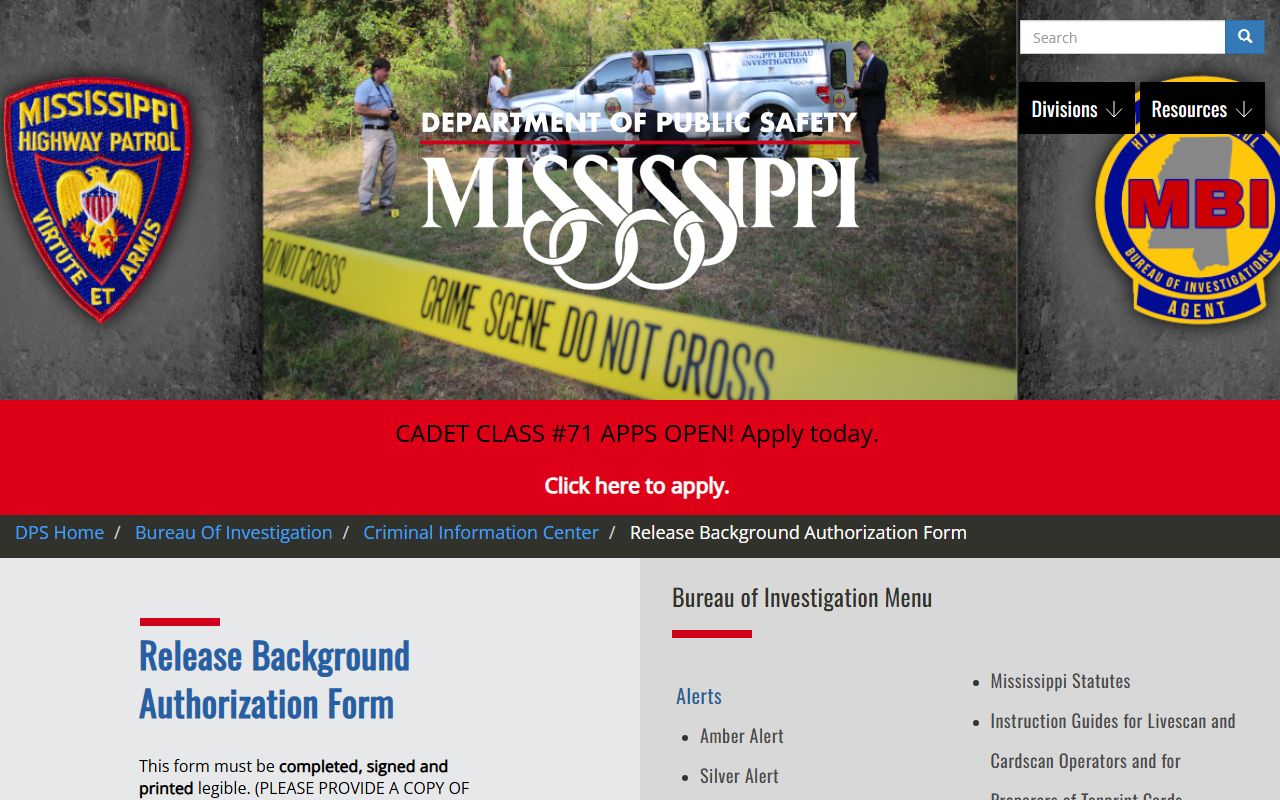
The signed form is what lets an employer or agency obtain a state criminal history. For a single Perry County case, by contrast, the public can read the open docket through MEC without a release.
The Mississippi Sex Offender Registry
The Sex Offender Registry is another DPS resource, and it sits apart from both the court file and the criminal-history repository. It tracks registered offenders by name and location rather than by case. It is useful for community awareness, but it is not a substitute for reading a Perry County criminal court record. The Mississippi Sex Offender Registry landing page lists its search modes and its warnings about data accuracy.
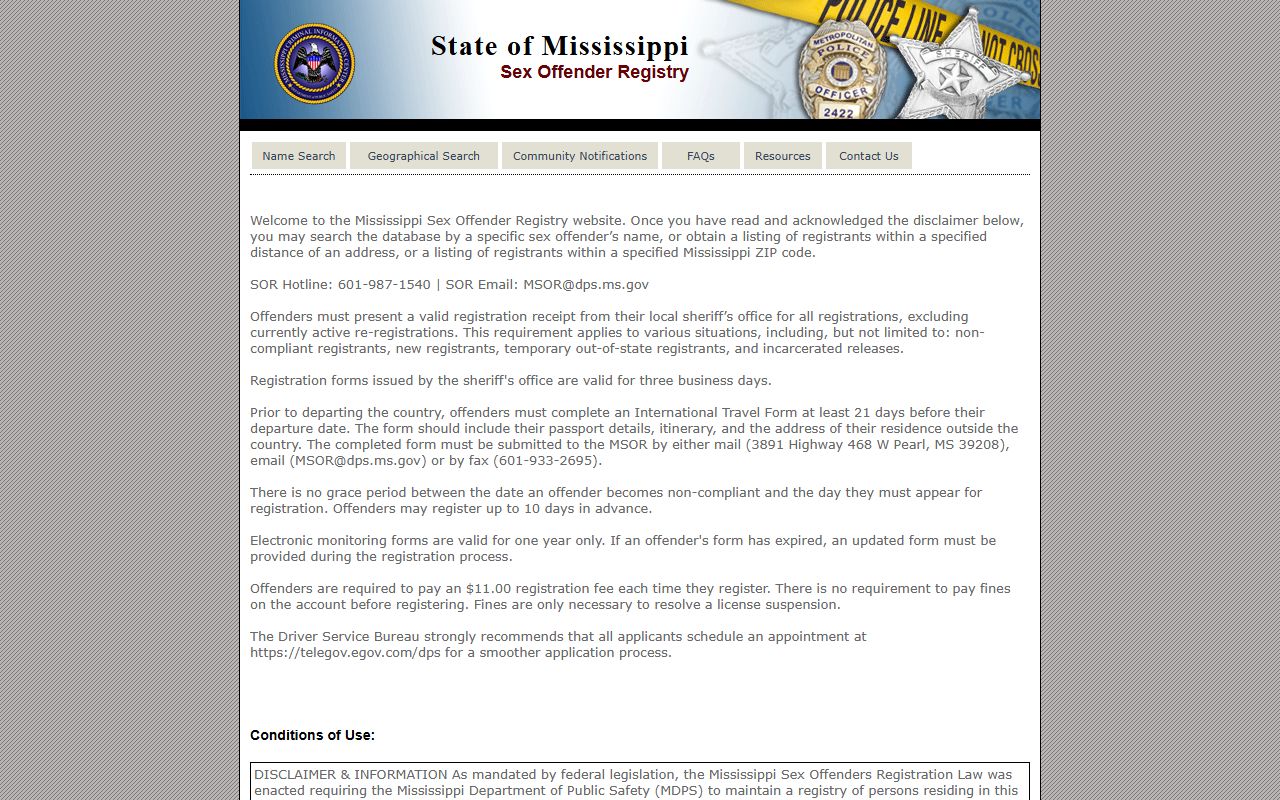
The registry offers three main ways to search, and each one answers a different question. A name search confirms whether a specific person is registered. The registry name search looks up a single offender by name.
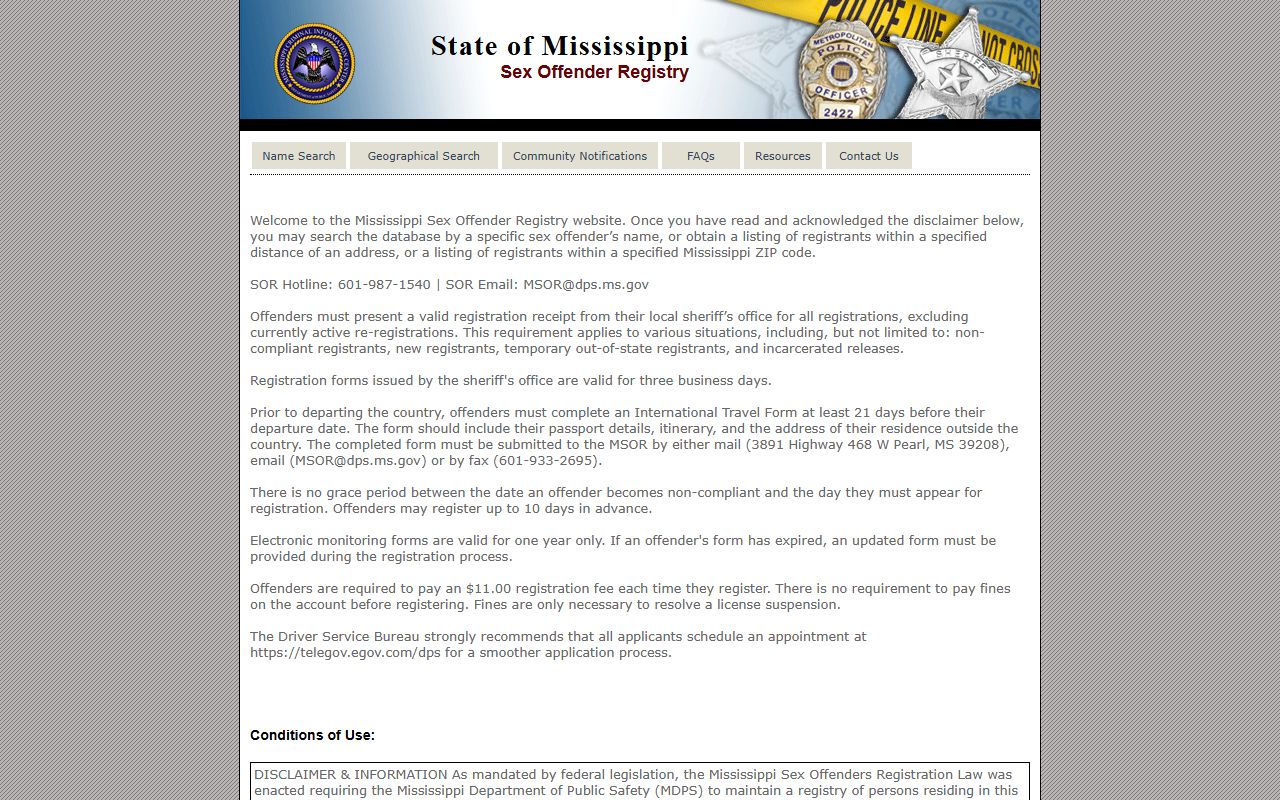
The name search returns a profile, not a court file, so a conviction's full detail still lives with the Circuit Clerk. A geographic search maps registered offenders near an address or within a chosen distance. The registry geographic search works by address, distance, or ZIP code.
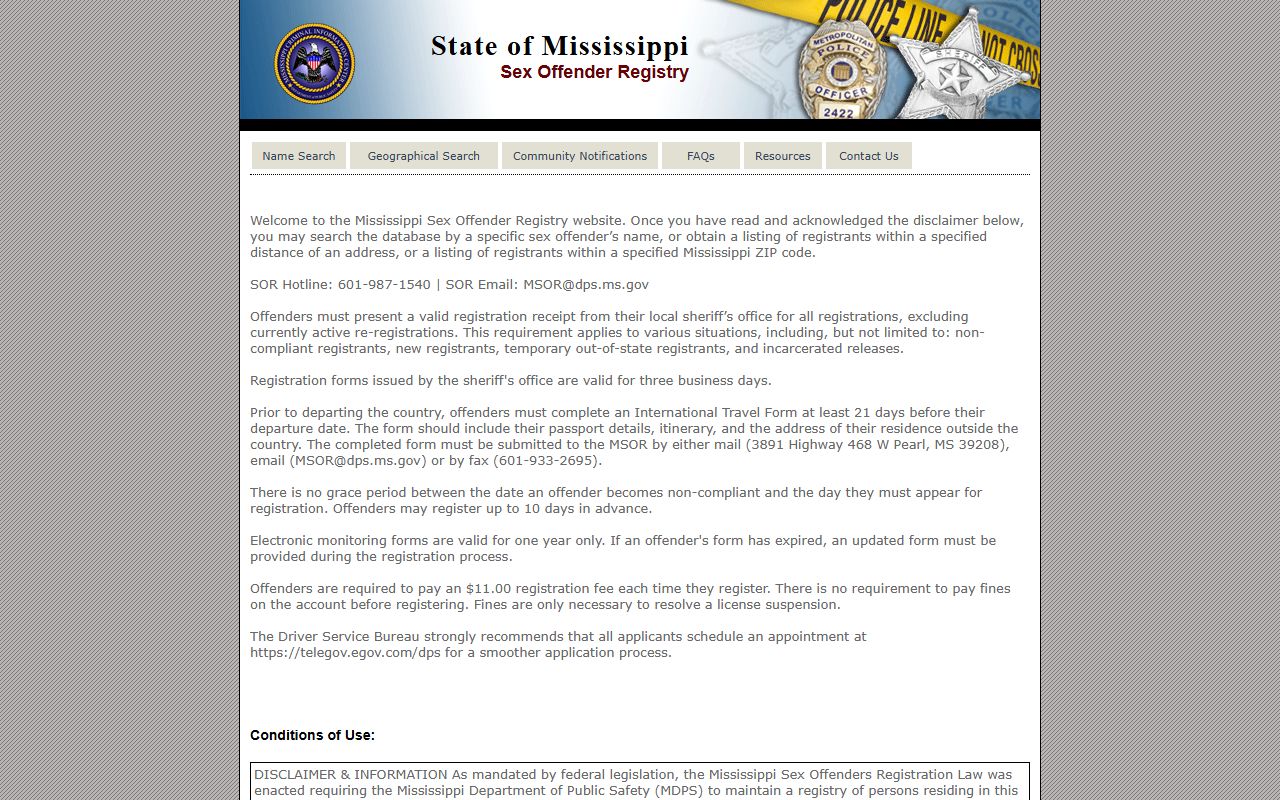
A distance search is best for checking a neighborhood, not for tracing one person's case history. Residents can also sign up for alerts. The registry community notifications page lets a user request email updates when a registered offender moves near a saved address.
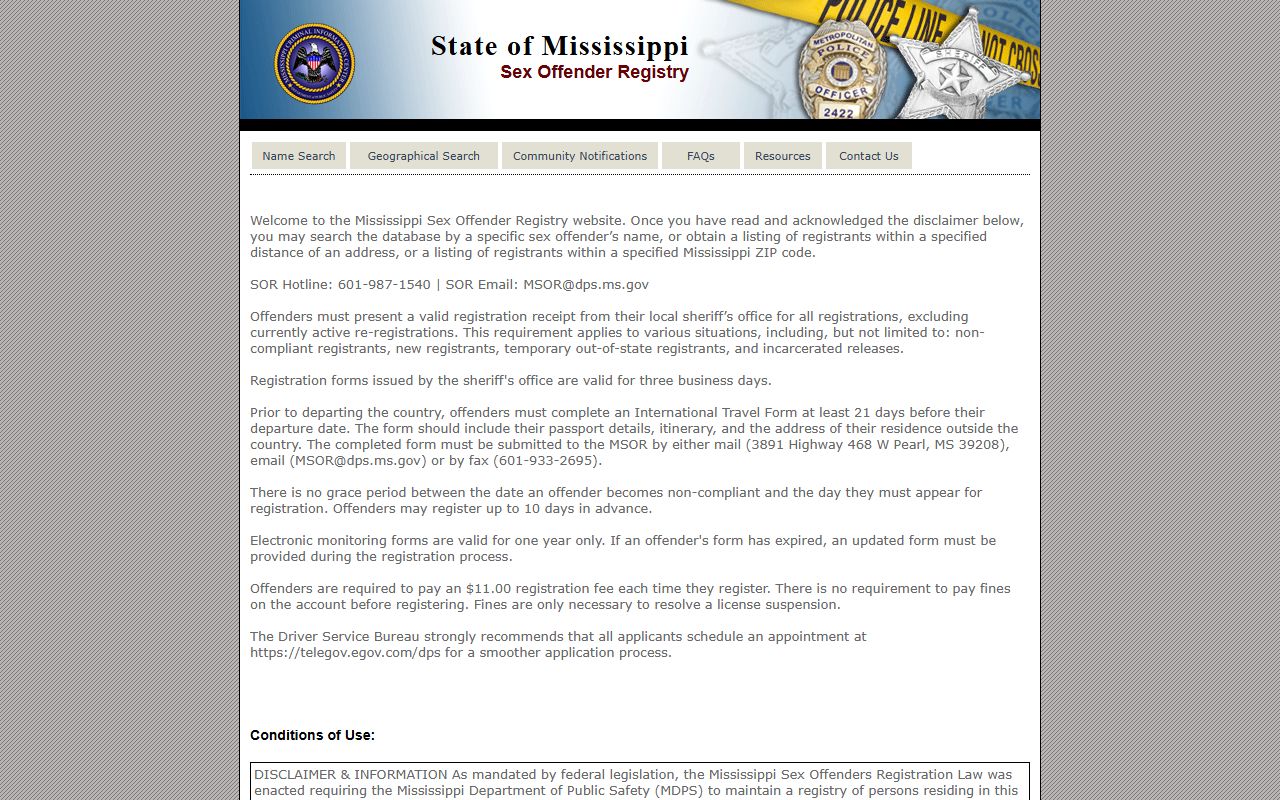
Notifications push changes to the subscriber, which the static court docket cannot do. DPS warns that registry data can change quickly and does not measure individual dangerousness, and that positive identification may require a fingerprint comparison. The SOR hotline is 601-987-1540 for questions about a listing.
Sealed vs. Expunged Criminal Records
Two different processes can pull a criminal record out of public view, and they are not the same. A sealed record is hidden from ordinary public access but still exists. An expunged record is treated by law as if it never happened. The Perry County Circuit Clerk notes that people who completed non-adjudicated probation may petition for expungement, and that certain felony convictions may be expunged when the statute's conditions are met.
| Sealed | Expunged | |
|---|---|---|
| Visibility | Hidden from the public | Treated as if it never existed |
| Law Enforcement | Limited access remains | Very limited; most agencies cannot use it |
| MEC Flag | Sealed or Sealed_Case | Expunged |
| Eligibility | Set by law or court order | Offense-specific under Miss. Code Section 99-19-71 |
Expungement eligibility is statutory and offense-specific. It depends on the offense type, the disposition, any waiting period, and prior record. Not every charge can be expunged. A person seeking either remedy files in the court of conviction, which for a felony means the Circuit Court and the Circuit Clerk.
Public Access to Perry County Criminal Court Records
Adult criminal case files are public records in Mississippi unless a specific law or court order restricts them. The public generally starts with the office that keeps the record, which for Circuit Court is the Circuit Clerk and, for electronic files, MEC through PAMEC. State law sets the framework for that access.
Key Statutes:
Mississippi Public Records Act, Miss. Code Ann. Section 25-61-1 et seq. makes public records available for inspection unless a law specifically exempts or restricts them.
Mississippi Judiciary public-records policy governs how the courts handle requests for records held by the judiciary, separate from case-document access through a clerk or MEC.
Restricted Perry County Criminal Court Records
Some criminal records are closed to ordinary public search even when an adult case would be open. Youth Court matters are the clearest example. Records involving children are confidential under Miss. Code Section 43-21-261 and are available only to authorized persons, agencies, or by court order. Juvenile delinquency, abuse, and neglect files are not searchable the way an adult Circuit Court case is.
Other records carry their own limits. The court can seal a case or a document so it does not appear in public access, and a person who needs sealed material usually must have party or counsel status or a court order. Active matters, ongoing investigations, and personal identifiers may be redacted. The categories below are commonly restricted in Perry County criminal files.
- Youth Court and juvenile delinquency records
- Sealed cases and sealed documents
- Expunged convictions and non-adjudications
- Social Security numbers, dates of birth, and account numbers
- Driver's license numbers in filed images
When a file is not online or appears restricted, the Circuit Clerk can confirm whether it is sealed, archived, or available only through PAMEC, and explain the copy and certification process.